She turned the rusted handle and heard
the heavy door groan on its elderly hinges. The dust-moted air she stepped into was stale
and undisturbed but strangely and immediately familiar, a relic of her
childhood indelibly etched along the stone threshold she was stepping over for
the first time since her grandfather had passed away.
It had been two years since the
funeral and the final afternoon gathered in the kitchen around the table where her
grandpa had once slathered butter thick on his bread while her grandma had poured
countless cups of strong coffee. There hadn’t been time or desire to wander
about the farm that day.
Just a heavy yearning to be. Together, quiet, weaving
what they knew might be a final memory.
Cousins. Aunts. Uncles. Nieces.
Nephews. Siblings. All of them assembled one last time on a February day far
drearier than it ever should have been. A dozen hearts quietly struggling to
fend off the fraying thoughts that threatened to pull them apart a hundred ways
over the coming months.
~~~~~
Winter had passed twice before she had
been able to drive the long road to the farm again. Her uncle, tending the
property while the estate was settled, said she was welcome to visit and take
whatever she wanted. And while she knew she couldn’t capture the familiar air
of her grandfather’s chicken coop, she hoped she might be able to capture some
of the essential rust. Wandering past
long rows of empty nest boxes and wired panels, she smiled at the memories of
helping fill the feeders with scratch grains and reaching quickly under a hen
to pilfer the smooth, warm treasure hidden beneath. Moving slowly and
deliberately, she looked for pieces both functional and nostalgic…an old John
Deere thermometer with chipping yellow paint…a garden rake worn smooth by rough
farmer hands…a vintage stoneware water bowl...a metal scoop from the grain
barrel. Everything had a right purpose and place in her mind. Until she approached
the window.


Coming to a carpeted shelf below the pane,
she stopped. Chicken pens lined either side, creating a kind of alcove. On one
side hung an old metal medicine cabinet. Inside, among the mud dauber nests,
were bottles of liniment and homemade hot-pick salve. She saw styptic powder,
scissors and antibiotics. Everything needed to treat an injury on a bird. Nailed
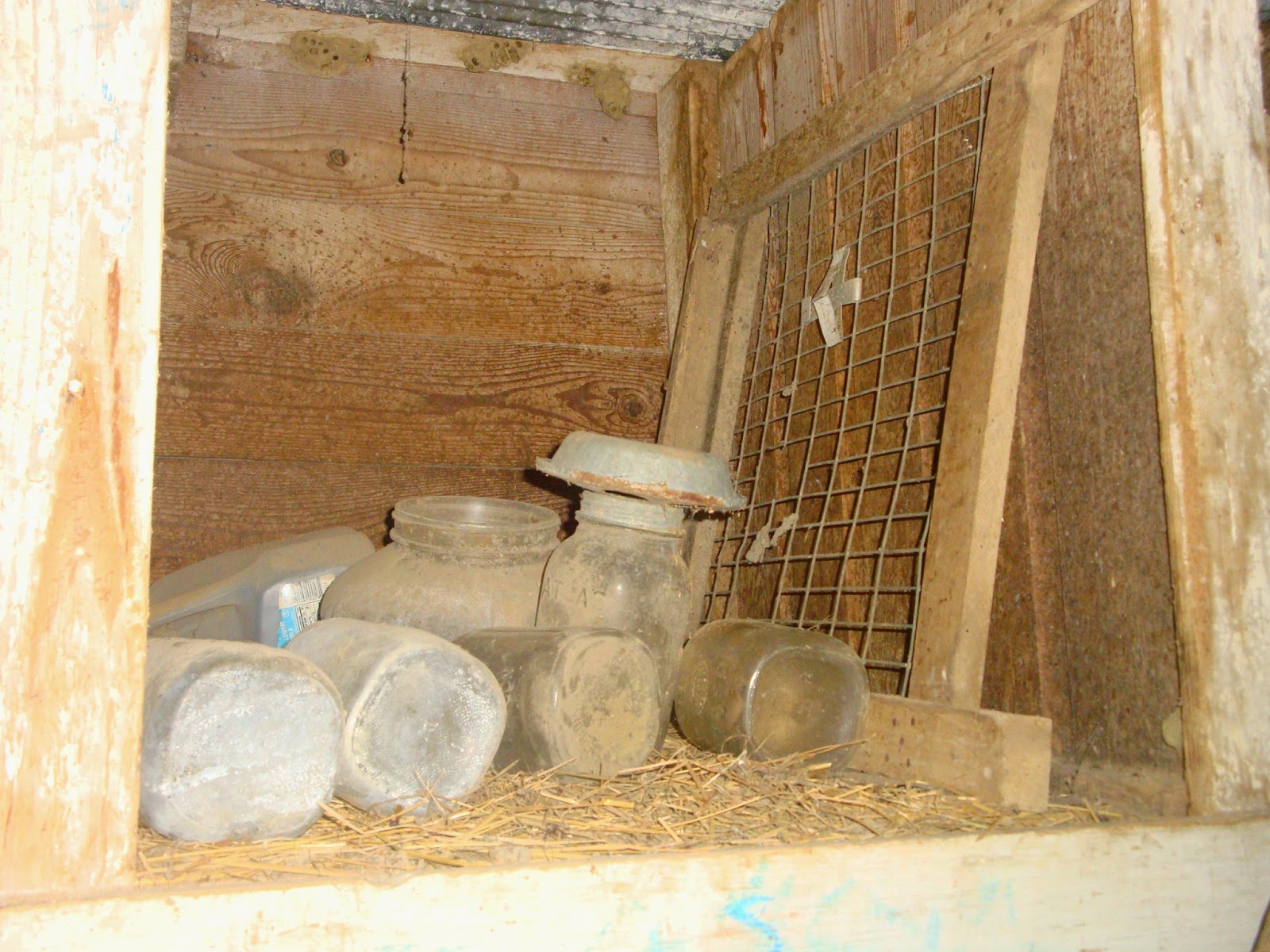
to the board above her head were lids, some orphaned, others holding glass jars
that contained an afterthought of sundry parts. The space there was thick with
cobwebs strung like gauzy chandeliers in a house long-abandoned. But it was the
mirror to the left that gave her pause. Clearly from a much earlier era, the
plaster frame had been ornately carved but was now crazed and crumbling,
humbled by a lifetime in the midst of barnyard debris. The glass was covered in
a layer of permanent dust, leaving any hope of practical use far behind. In all her years of walking through the coop,
she had never noticed it and now couldn’t imagine what purpose it might have
served.


Build a comfortable ledge to lay down an
injured bird? Yes. Install a cabinet for holding the blood-stop
and Teramyacin? Yes. But hang a
decorative mirror for chickens? Why?
As she pondered the mystery, the reason crystallized in a sudden rush of
memory. In the coop, she had learned how to pickpocket eggs from a nesting hen.
But outside, she had learned how to tightrope walk the roosters’ tethers to
keep from getting flogged.
You see, her grandfather, like his
father and countless other men of their generations, had not only raised laying
hens. They had raised gamecocks as well. She then remembered the tarpaper A-frames that lined one edge of the yard
and the literal game of chicken played by the cousins to see who would cross
the rooster’s perimeter and walk the line before a spur could slice a shin
bone. She remembered the stack of game fowl magazines next to the couch in the
living room and the plywood traveling boxes as they were loaded in the back of
the pickup truck. It all made sense in that moment of flipping back through her
mind’s memory album.
The mirror was for training roosters.
…to
churn their warrior instinct.
…to
agitate their gladiator passion.
…to
cement their rage against the semblance of themselves so that the first thing
they attacked when entering the fighting ring was the shape they dimly recognized
from their own reflection.
Standing there in the dust and
emptiness, she also recalled the day she herself had raged against Grandpa. Probably
ten or eleven years old, she had overheard the menfolk talking about going to a
cockfight. Something had snapped in her and she burst into tears, screaming
about horrible people and heartless pastimes. She had run out of the house
trailing hot fury behind but was marched back inside immediately by her mother
who demanded she apologize for her slashing disrespect. She didn’t have to agree
with their choices but such insolence toward her elders would not be tolerated
and so she had stammered her contrition from angry, trembling lips.

At some point along the way, her
grandfather had left the bloody business behind. Somewhere between her adolescent
outburst and the onset of her adult years, the rooster tethers were pulled and
the traveling boxes were stacked on the rafters of the coop where the mud wasps
found seclusion for their earthen constructions. Eventually, her carefree days
were packed away as well, replaced by wedding plans and moving trucks and then
the long years of career expansion and family building. And the lips, once
flushed with anger, then pressed fond kisses against her grandfather’s paling cheeks
on the rare days of visits to the farm. How she wished time now permitted
more.
But Grandma had passed some 4 years
earlier and Grandpa had decided to go 2 years later. The remembrance of their absence blinked her
back into the present moment and she felt afresh the puncture wound in her
heart that had been unhealable since that day. Abruptly, she reached out to
lift the mirror from the rusty nail. Having no idea what the filmy glass might
be used for, she only felt a deep need to remove it from that conflicted place.
So into the box with the grain scoop and the chipped thermometer and the Mason
jars it went.
~~~~~
Winter came again with its crackling
breath and catenating tentacles, pressing warm flesh deeper into burrows of
fleece and pools of tea like a pursuing hound driving a fox into the depths of
its den. She forgot about the box of farm relics, now stowed on a shelf in the
tool shed, as her thoughts turned inward to the unfinished needlepoint in the
sewing box and the stack of books that had been patiently waiting on her
attention all summer long. It was the hardest season for her to endure as
daylight shriveled and the nights seemed to swindle strength from a feeble sun.
It had been the hardest months for her
grandfather to endure as well. The deep winter ache that unfolded fresh burdens
on a body. The brooding thoughts that seemed too far from the rescue of an
early April breeze. She understood the struggle as she waited for the surfactant
of spring to arrive. But understanding, even empathizing, was no surrogate for
knowing. Peace remained elusive as the flogging of her heart raged on.
During one of those brittle winter
evenings, while curled up, listening to the scraping winds rake the naked
forest, she picked up a book about the ancients of Rome and their pursuit of
beauty. She read about the thick, slathered makeup and aromatic pastes and the
heavy, jeweled adornments that pulled earlobes low. And there, in a chapter
about the earliest mirrors, she found a piece of her missing peace.
Nothing more than plates of polished bronze
or copper, the book explained, a primitive mirror gave only distorted,
perplexing images to the viewer. As a result, the ancients would never have
known the fine features of their faces, seeing a fun-house warp of misshapen
lines and contorted curves instead. With a furrowed brow, she contemplated the strange
thought of struggling to recognize oneself and of having so many doubts about
one’s appearance. The light of this revelation led her into the creases of
Paul’s Corinthian epistle. Setting aside the history book, she flipped open her
Bible to the thirteenth chapter and read the riddle again.
For
now we see through a mirror dimly {enigmatically, darkly};
but then {when perfection comes}, face to face;
now
I know in part {imperfectly};
but then shall I know {fully and clearly} even as
also I am {fully and clearly} known.
~1 Cor.13:12 Amp.
She had always
wondered why Paul was inspired to say it was impossible to see clearly in a mirror.
It made no sense, unless it was covered in dust and grime or was cracked into a
spider web of splintered, jagged reflections. She had often mulled over this mystery
of how looking into a mirror could be an enigmatic, dark way to see oneself. It
seemed, rather, it should be the form of highest clarity.
Then suddenly, it
all dropped into place. In a stunning revelation of God’s unreasonable love,
she understood. Paul’s mirror wasn’t like the rooster’s mirror that she had
discovered in the coop, but was rather a bronze plate that offered a muddled
reflection. And perhaps more significantly, it symbolized the presence of
judgment in the Bible. Time and again, disobedience, self-righteous pride,
punishment took the form of bronze…Moses’ bronze snake in the desert, Goliath’s
bronze helmet and spear, the bronze altar where sin offerings were burned.
No one, then,
striving to discern their identity can see themselves as forgiven, beloved,
accepted while gazing into bronze. And even the clearest, most
polished plate offers nothing more than cement that binds us to condemning
rage. Not until our eyes have been turned away from the ruins of self and fixed
on Love can the ache be relieved. That is the meaning of Paul’s mystery: we
will know all things about God’s unplummable heart for us when we are face to
face with the One who bore away our bronze.
There in the dead
of winter she felt her lungs fill with warm, nourishing air. At last, the dying
corner of her heart split itself open to life. Her squinting eyes ceased from
their futile mirror-peering and the tethers of Why and How could
and What if that had trapped her in long months of soul-suffocation slipped off.
At last she knew.
Rest, apart from
answers, came softly.
Peace settled her,
to the higher plains of holy.
And in that moment,
patient, persistent, gracing Love who had always known…
her and him,
them,
all…
stepped across the ancient threshold into their common dust to free
the captives.
There is therefore, now no condemnation for
those in Christ. ~Romans 8:1
So if the Son sets you free, you are truly
free. ~John 8:36
 This is the fifth summer that the kids and I have raised Monarch butterflies. A few weeks ago, we found 11 eggs in the milkweed garden and eventually 7 made it to metamorphosis stage. One by one, 6 plump caterpillars transformed into beautiful jade-colored chrysalises dotted with gold that hung like chandeliers in a ballroom. The last caterpillar, however, had been slow to keep pace and I noticed that his antenna were bent backward at an odd angle. Concerned, I was happy when he finally took his place upside-down in the familiar “J” position alongside his siblings.

 Anytime I’m teaching the kids about the cycles of nature, I try not to hide the difficult parts from them. We’ve examined dead birds found on our walk back from the bus stop. We’ve discussed what happens to baby bunnies that bounce out of the nest too soon. They’ve watched enough TV shows about the hunter and the hunted to understand that not every animal returns to its home at night. And now they were learning that not every caterpillar gets to soar.
 Far from the splendor and perfection of those 6 jade vessels, my sanctification in the Lord much more closely resembles that of the last caterpillar. Stuttered, struggling, seized by the remnant curse and utterly bereft without His gentle, omnipotent guidance, I rely on Him completely to see me through this life's daily transformation process.